Roots, Recipes, and Red Sauce: The Italian Immigrant Families Who Cooked Paramus Into Existence
Photo: U.S. Army USAG-V by Anna Ciccotti, Public domain, via Wikimedia Commons
Somewhere in Paramus, there is almost certainly a freezer containing sauce that was made weeks ago, portioned into old ricotta containers, and labeled in handwriting that belongs to someone's grandmother. That sauce — tomatoes, basil, maybe a little onion — is the through line. It connects a post-war Italian immigrant stepping off a boat in New York Harbor to a Bergen County family ordering dinner on their phones in 2024.
The story of how Italian food became synonymous with Paramus isn't a restaurant industry story, not really. It's a family story. A migration story. And it starts much earlier than most people realize.
The First Wave: Building Something From Nothing
The years immediately following World War II brought a significant surge of Italian immigration to the United States, and the New York metropolitan area absorbed a substantial portion of those arrivals. Many settled initially in Brooklyn, the Bronx, and lower Manhattan — neighborhoods with existing Italian enclaves that offered community, familiar language, and the comfort of proximity to people who understood you.
But as the 1950s rolled into the '60s, something happened that would reshape the entire region: suburbanization. Italian-American families who had built modest stability in the city began looking across the Hudson. New Jersey offered space — actual physical space, with yards and driveways and school districts that felt like opportunity. Bergen County, and Paramus specifically, became a destination.
They didn't come alone. They brought their kitchens with them.
Not the physical kitchens, obviously, but the knowledge inside them. Recipes that had never been written down because they didn't need to be — they lived in muscle memory, in the instinct to add a pinch more salt, in the knowledge of when a sauce was ready by the way it smelled. That knowledge crossed the Atlantic and then the Hudson, and it took root in Bergen County soil.
What Home Cooking Became
For the first generation of Italian families in Paramus, food was never just sustenance. It was identity maintenance. In a country that didn't always make immigrants feel fully welcome, the Sunday table was sovereign territory — a place where language, tradition, and belonging were non-negotiable.
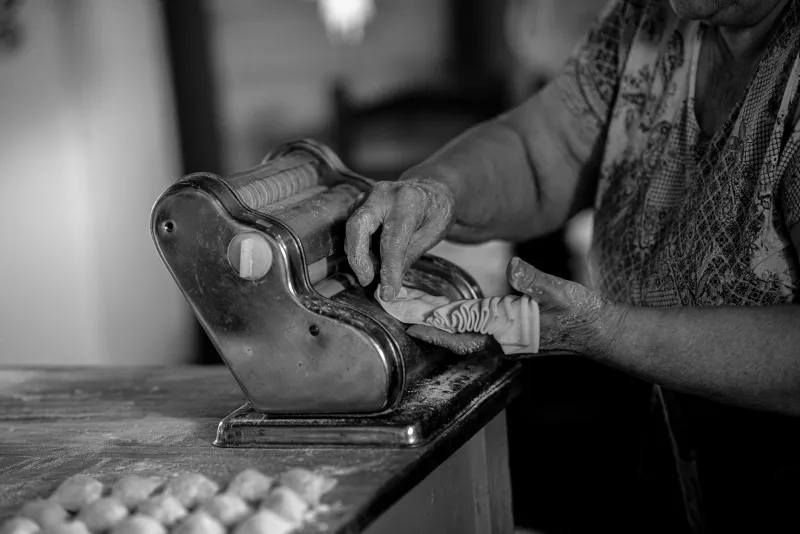
The women, in particular, carried enormous culinary authority. Nonnas who had grown up watching their own mothers cook in Calabria, Sicily, Campania, and Lazio replicated those traditions in American kitchens equipped with unfamiliar appliances and ingredients that weren't quite right. They adapted. They found the closest approximation to what they needed, and when they couldn't find it, they made do in ways that sometimes produced something even better.
One longtime Paramus resident, now in her eighties, recalls her mother spending the better part of every Saturday preparing for Sunday dinner. "She'd start the gravy in the morning," she says, using the Italian-American term for slow-cooked tomato sauce that's simmered with meat. "By the time we sat down to eat, the whole house smelled like it. The neighbors knew what day it was by the smell coming from our windows."
Those aromas were, in a very real sense, the beginning of Paramus's food culture.
From Home Tables to Storefronts
The transition from private kitchen to public business happened gradually and, often, accidentally. A woman who made exceptional mozzarella for her family started making extra for the neighbors. A man who knew how to cure meats the way his father had in Salerno began selling from his garage on weekends. A family with a large enough space opened a small restaurant because people kept asking if they could pay to eat what they'd been eating as guests.
These weren't calculated entrepreneurial ventures. They were extensions of hospitality, formalized because demand required it.
By the late 1960s and through the 1970s, Paramus had developed a genuine Italian specialty food infrastructure. Importers who catered specifically to the Italian-American community brought in products that made homesick immigrants feel seen: specific pasta shapes, canned tomatoes from particular regions, cheeses that couldn't be found in standard American grocery stores. That supply network, built to serve family kitchens, eventually became the backbone of a restaurant industry.
The Second Generation's Inheritance
For the children of those original immigrants — Americans by birth, Italian by upbringing — the culinary inheritance was complicated. Some rejected it, eager to assimilate and move past what felt, in the context of American middle-school cafeterias, like an embarrassing otherness. Others held on fiercely, understanding even as teenagers that what their families cooked was worth preserving.
Many of Paramus's most respected Italian restaurants today are run by people in this second or third generation — individuals who grew up eating real food and eventually made the conscious choice to make it their life's work. They bring something to their kitchens that can't be taught in culinary school: an embodied understanding of what Italian food is supposed to taste like, formed not from textbooks but from thousands of Sunday dinners.
"My grandmother would have hated the word 'authentic,'" laughs one Paramus restaurant owner whose family emigrated from outside Naples in the early 1950s. "She just cooked. She didn't think of it as preserving a tradition. She thought of it as feeding her family. But that's exactly what made it real."
The Legacy Lives in the Delivery Box
There's something quietly profound about the fact that the food traditions carried across an ocean by Italian immigrant families now travel the last mile in a delivery bag to someone's front door. The distance from Nonna's kitchen to your couch is measured in generations, not just miles.
When you order from a Paramus Italian restaurant through Mangiamo — a bowl of Sunday gravy over rigatoni, a plate of baked ziti, a properly made chicken parm — you're eating something with a longer history than the restaurant that prepared it. You're tasting the accumulated knowledge of people who believed, without question, that feeding others well was one of the most important things a person could do.
The families who built Paramus's food legacy didn't set out to create a culinary destination. They were just trying to feel at home. The fact that their kitchens became the foundation of something so enduring is the most Italian outcome imaginable: community built around a table, one meal at a time.
That freezer full of sauce? It's still out there somewhere. And someone is almost certainly defrosting a container of it tonight.