Off the Radar and On the Money: How Paramus Became a Quiet Capital of Real Italian Food
There's no Michelin inspector parking in the lot on Route 17. No food blogger has ever made the pilgrimage to a strip-mall trattoria in Bergen County just to post a flat lay of the cavatelli. And honestly? That's probably the best thing that ever happened to Paramus Italian food.
Because while the rest of the food world has been busy chasing trends, curating tasting menus for influencers, and arguing about which West Village spot does the definitive cacio e pepe, something quietly remarkable has been happening out here in the suburbs. Real Italian food — the kind made by people who learned it from someone who learned it from someone else — has been finding a home in Paramus, and it's been doing so completely under the radar.
That's not a complaint. That's the whole point.
The Invisibility Advantage
Here's a counterintuitive truth about the restaurant industry: media attention is a double-edged knife. Sure, a glowing review in a major publication can pack tables for months. But it also changes things. Menus get tweaked for a broader audience. Presentation starts to matter more than flavor. Prices creep up to match the new perception. And somewhere along the way, the dish that made the place special gets buried under the pressure to perform for strangers.
Paramus doesn't have that problem. The restaurants here aren't cooking for critics. They're cooking for the families who've been ordering from them for fifteen years, the regulars who call ahead and don't even need to say their name, the people who grew up eating this food and know exactly what it's supposed to taste like. That's a completely different kind of accountability — and in a lot of ways, it's a stricter one.
You can fool a food critic with a beautiful plate. You cannot fool someone's grandmother.
What Tourism Does to a Food Scene
Spend a little time in any city that's become famous for its food culture and you'll notice something: the places that get written about the most are rarely the places the locals actually eat. The tourist economy creates its own gravitational pull, drawing menus toward the familiar, the photogenic, and the broadly appealing. Authenticity becomes a marketing term rather than a practice.
Paramus sits entirely outside that economy. Nobody's driving up from the city specifically to eat here. There's no culinary tourism infrastructure to cater to, no obligation to make the food more accessible to people who don't know the difference between Neapolitan and Sicilian. The restaurants here get to just... cook. The way they've always cooked. For the people who've always shown up.
That freedom is worth more than any press mention.
The Instagram Problem (That Paramus Doesn't Have)
Visual social media has done some genuinely strange things to food. Dishes get designed for the photo first and the palate second. Portions get exaggerated. Colors get dialed up. Sauces get drizzled in arcs rather than ladled with purpose. The result is food that performs well on a screen and lands somewhere between fine and forgettable on an actual plate.
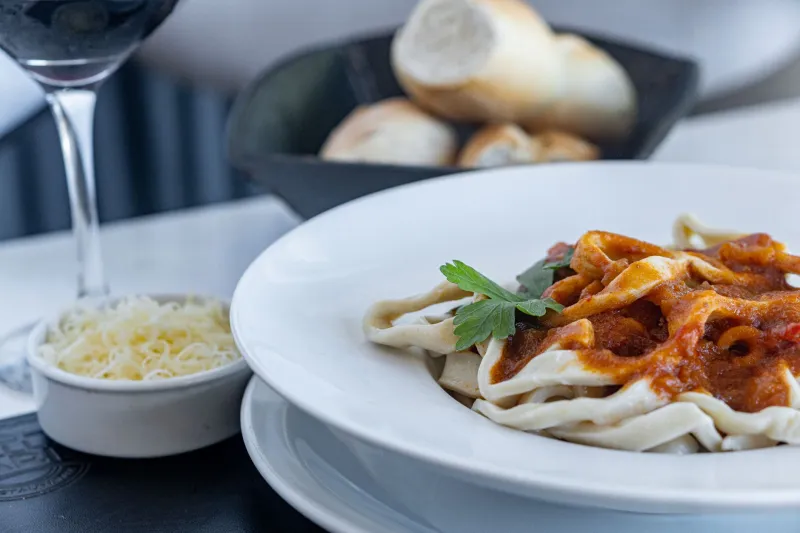
Paramus Italian kitchens are not optimizing for your feed. The braised short rib ragu looks exactly like it should: dark, glossy, deeply savory, spooned over pasta with zero interest in whether the lighting is right. The eggplant parmigiana is stacked the way it's always been stacked — not because it photographs well, but because that's how it holds together. The tiramisù arrives in a portion that suggests whoever made it actually wants you to enjoy it.
There's something almost radical about food that exists entirely for the purpose of being eaten.
Who Actually Knows Where to Order
The people eating the best Italian food in Paramus right now aren't foodies, in the traditional sense. They're not people who read restaurant columns or follow chefs on social media. They're the couple who moved here from Calabria twenty years ago and immediately recognized something familiar in a kitchen down the street. They're the family that orders every Sunday because it's easier than cooking and better than anything else within a thirty-minute drive. They're the adult kids who moved back to Bergen County and immediately reestablished their takeout habits.
This is a word-of-mouth food scene. It always has been. You find out about a great spot because your neighbor mentioned it, or because you saw someone in the parking lot carrying a bag that smelled incredible and you asked them where it came from. That's how good restaurants survive here — not by chasing attention, but by delivering consistently enough that the people who found them never stop coming back.
The Delivery Factor
One thing that's changed in recent years is that the reach of these kitchens has gotten longer. Ordering directly from a Paramus Italian restaurant and having it arrive at your door has made the geography feel a little smaller. You don't have to live two blocks away to be a regular anymore. You just have to know where to order.
And that's genuinely exciting — because it means more people are discovering what the longtime locals have always known. The food is here. It has been here. It's being made by people who care deeply about it, who aren't cooking for recognition or chasing a trend cycle, who are simply putting out the best version of dishes that have been part of their family for generations.
No press release required.
Why This Matters Beyond Paramus
The story of Paramus Italian food is really a story about what happens when a food culture gets to develop on its own terms. No outside pressure to modernize, no incentive to perform for an audience that doesn't understand the reference points, no reason to dilute the thing that makes it worth eating in the first place.
The result is a dining scene that functions the way Italian food culture is actually supposed to function — rooted in place, sustained by community, and accountable to the people who eat it every week. It's not flashy. It's not going to trend. But it's real in a way that a lot of celebrated restaurant food simply isn't.
Somebody in Paramus is eating a plate of pasta right now that would make a food critic weep — and that food critic has absolutely no idea it exists. That's not a tragedy. That's the whole secret.